Welcome to Validation Season
Last week, one of my close friends said, “Can you do me a favor and stroke my ego for a second.”

I laughed (a lot), but it stuck with me. Because we don’t really do that enough, do we?
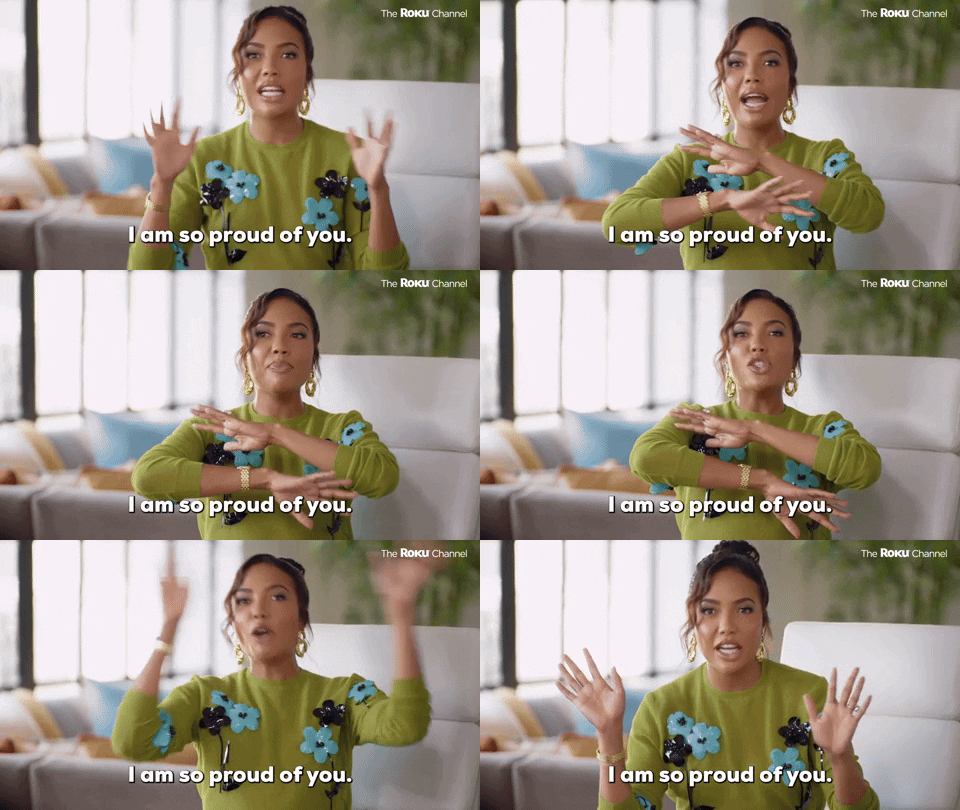
Not the empty kind, the “🔥” emoji kind, but the real, intentional kind. The I see you. I’m proud of you. Don’t give up yet.
We assume the people around us already hear it. Their partner probably says it. Their followers definitely do. But even the most grounded, confident people, the ones who always clap for everyone else, need to be reminded that their effort matters.
We live in a culture that celebrates the finish line but rarely the miles it took to get there. The quiet work. The uncertainty. The days when showing up was the only win. Sometimes the strongest people still need to hear: You’re doing great. Keep going.
But here’s where it got interesting.
A few days later, I was talking to another friend who said she hates the idea of someone asking for validation.
She said it feels strange, maybe even weak, to need to hear it out loud. That if you really know who you are, you shouldn’t need anyone else to say it.
And I understood that too.
Because on one hand, it is powerful to be self-assured, to move in silence, to find peace in your own reflection.
But on the other hand, we’re human. We’re social. And sometimes, asking for validation isn’t about ego. It’s about wanting to be witnessed.
Later that night, I went down a Reddit rabbit hole about ego-stroking. Someone wrote something that stopped me:
“It’s probably a good idea to be kind and encouraging as a default, but that isn’t always appropriate. Sometimes it can be dishonest, even manipulative. Compliments that aren’t grounded in truth can do more harm than good.”
That hit. Because it’s true. There’s a fine line between validation and inflation. Between encouragement and exaggeration. Between support that strengthens someone and words that feed them something hollow.
So maybe the point isn’t to stroke egos, but to see people honestly.
To celebrate what’s real.
To affirm what’s growing.
To challenge what needs care.
To remind people they’re worthy, not because they’re winning, but because they’re human.
Ego-stroking, when done with intention, isn’t about performance. It’s about presence. It’s how we say, I see you. I know how much this costs. And I’m here, even when it’s quiet.
So yeah, stroke your friends’ egos, but make it mean something. Because real affirmation isn’t noise; it’s nourishment.